
Genesis of Christella Gasugi Dreams of Becoming a Doctor Leading with Innovation
Christelle Gasugi Ikirezi Sandrine grew up watching her mother command a classroom of secondary students with a kind of quiet authority that doesn’t need volume to be heard. As a head teacher, her mother embodied a particular kind of strength, the kind that shows up every day, that meets resistance with patience, that builds something meaningful from consistent effort.
“My mom is the hero of my life,” Christelle says. “Sometimes you do things to please who you love, and it turns out to be the best thing you could ever do.”
Growing up in a middle-class household in Huye, Christelle found her natural rhythm in the sciences. Physics and chemistry made sense to her. Biology revealed patterns she could trace and understand. Her name appeared consistently at the top of the class rankings, a position that felt both earned and expected. Mathematics, however, resisted her efforts in ways the other subjects never did. When frustration threatened to overwhelm her, her mother’s voice would surface with quiet insistence: there is no harm in trying.
After her parents separated, Christelle’s mother raised her alone. She watched her mother navigate single parenthood with a kind of determined grace, managing household finances, advancing in her career, building a life that didn’t require permission or partnership to be whole. The lesson wasn’t delivered in speeches; it was written in every decision her mother made, every bill she paid independently, every choice she made without having to ask anyone else. “She always said, be financially stable before marriage; your freedom depends on it,” Christelle recalls. Those lessons became her foundation, a reminder that success is about more than grades; it’s about choice, self-respect, and purpose.
In Senior Five, Christelle joined the Wavumbuzi Entrepreneurship Challenge, a decision motivated less by participating in the Challenge and more by the promise of internet connection.
“My teacher even asked why I was there since I didn’t like entrepreneurship,” she laughed.
But everything changed when she joined the banking quest. For the first time in her academic career, she began to understand money beyond pocket allowances, how it’s earned, managed, and valued. “You don’t learn that in Physics or Chemistry,” she says. “It opened my eyes to how the real world works.”
Academic excellence, Christelle realized, might open doors, but understanding opportunity, recognizing patterns in problems, thinking creatively about solutions, these were the skills that gave you the courage to walk through those doors. Wavumbuzi sparked her curiosity, stimulating her ability to see problems not as obstacles to avoid but as puzzles worth solving, challenges that might yield to the right combination of creativity and initiative.
After high school, during her gap year, Christelle decided to test what she had learned. She requested a small investment from a family friend and started selling jewelry and phone cases. At the same time, she tutored students in the mornings, and the afternoons were reserved for managing her business.
“I wouldn’t have done it if it wasn’t for Wavumbuzi,” she says. “It gave me the courage to try, to fail, and to start again. I realized I don’t have to wait until I’m older or employed to build something of my own.”
Though it was a small business, what it taught her was significant. Christella gained confidence, financial awareness, and a deep appreciation for independence. She began to understand the kind of independence her mother had been modeling all along, the kind that comes from knowing you can create value, generate income, build something without waiting for someone else to grant you permission or opportunity. “It taught me to value time, money, and consistency, lessons no classroom can give.”
At twenty, Christelle is now studying medicine at the University of Global Health Equity, and is embracing her journey with a new purpose. Though she once dreamt of pharmacy, she has found her passion for healthcare and innovation. She aspires to merge her medical knowledge with entrepreneurial thinking. The goal is to design solutions that make healthcare more accessible, particularly for women and young people. It’s a vision that draws equally on her scientific training and her understanding of how to recognize opportunities, mobilize resources, and create something where nothing existed before. “Wavumbuzi helped me think beyond my career,” she says. “You can be a doctor and still be an entrepreneur, a thinker, and a creator.”
Christelle carries her lessons with her, the model of quiet strength from her mother, and the reminder that there’s no harm in trying. But the voice driving her forward now, the one making plans and seeing possibilities and refusing to wait for permission; that voice is entirely her own. One, shaped by courage, curiosity, and conviction.
“I don’t want my story to be about survival,” she says firmly. “I want it to be about becoming a doctor who leads with innovation, finding solutions that close gaps in healthcare and open new possibilities for others”
Beyond the Drawing Board: The Making of an African Entrepreneur
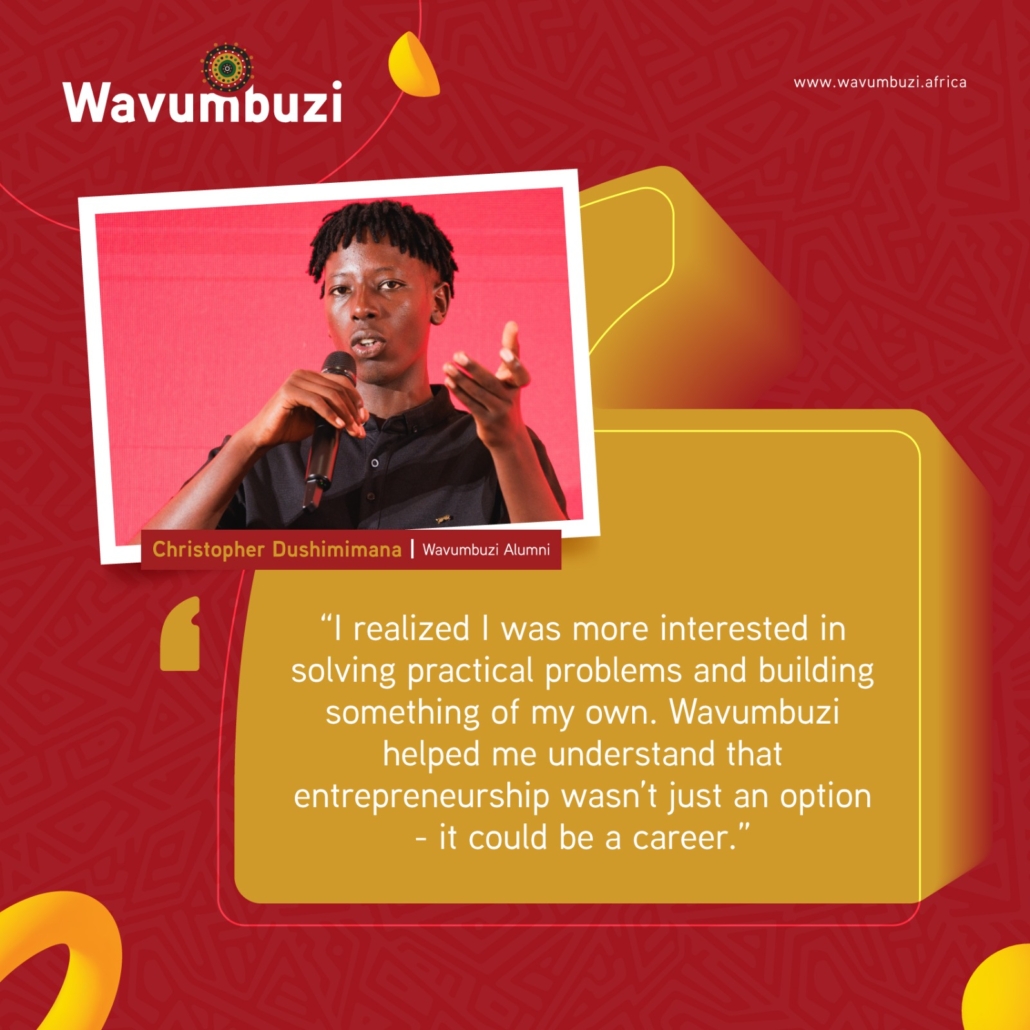
Christopher Dushimimana, 21, grew up in Nyagatare, Rwanda, as the firstborn in a family of four. With a businessman father and a nurse mother, he was raised with both enterprise and empathy. Known for his stubborn streak as a child, Christopher showed early signs of determination and curiosity. By his teenage years, he was already trying out small ventures, saving his pocket money to make soap, organizing youth groups, and supporting people with disabilities to produce and sell goods in the local market.
He was not just thinking about money. He was thinking about how things worked and how they could work better.
Christopher actively engaged in the Wavumbuzi Entrepreneurial Challenge while in secondary school. For him, it was the first time entrepreneurship was not just an idea, it became something he could practice. “Wavumbuzi was different. It was not about theory, it was practical. We were solving real problems, making real decisions, and learning how to lead,” he recalls.
Through the Creative Industries Quest, he gained hands-on exposure to leadership – leading a diverse team of peers, including students older than him – while developing skills in communication, planning, and strategic thinking. He learned how to work through customer needs, resource constraints, and feedback cycles. With limited tools, he practiced building real solutions. Wavumbuzi helped him in moving his innate drive into structured action, equipping him with entrepreneurial knowledge, tools, and systems to organize ideas, test them, and reflect on outcomes.
The program also shifted his mindset. He no longer feared failure. Rather, he became more confident in testing and refining ideas. He learned to lead with clarity, not just confidence. Iin 2023, he launched three ventures, all of which failed. But each experience gave him practical insights into timing, product fit, and execution. Around the same time, he began studying Chinese. When one venture did not work out, he started tutoring others in Chinese to raise money, another example of recognizing opportunities and acting on them.
Academically, Christopher had excelled. He was among Rwanda’s top performers in Mathematics and earned a scholarship to study in Russia. But after Wavumbuzi, his thinking had changed. “I realized I was more interested in solving practical problems and building something of my own. Wavumbuzi helped me understand that entrepreneurship was not just an option—it could be a career.” So, he made a deliberate choice to pursue entrepreneurship.
Today, Christopher is studying Software Engineering and Marketing at the African Leadership University. He is also the founder of CDY Agency, a creative and brand strategy firm that helps African businesses grow their visibility, tell their stories, and compete in a digital-first world. “CDY Agency is how I bring everything together—creativity, technology business, problem-solving—and use it to help others build,” he says.
His long-term vision is to grow CDY Agency into a leading creative-tech firm across the continent, helping African brands scale through digital tools, strategy, and smart storytelling. He wants to mentor other young entrepreneurs, build solutions that reflect African creativity, and support businesses that move beyond survival toward sustainable growth.
Wavumbuzi did not just introduce Christopher to entrepreneurship. It gave him practical exposure, the space to lead, and the mindset to keep going when things did not work out. It shaped how he sees himself, how he approaches problems, and how he builds for the future. His story is a clear reflection of what happens when young people are given the chance to test ideas early, fail safely, and choose their own path with confidence.
Wavumbuzi 7 years Longterm Impact Report
