
Ideas Only Matter When You Act: How Derrick Turned Thought into Innovation
Derrick Okoth grew up in Eldoret, Kenya — the legendary home of champions, famous worldwide for producing record-breaking athletes who carry the nation’s flag to global podiums. But despite the energy and fame surrounding his hometown, Derrick himself wasn’t loud or bold. Behind his calm demeanor lived a storm of ideas. “I had so many ideas,” he says, “but I used to keep them to myself.
What he couldn’t express in words, he channeled into movement, through sports. Tennis and swimming became his language. He excelled enough to represent his school at the Kenya Secondary Schools Federation competitions, a distinction that marked him as someone who could perform when it mattered. But home told a different story. His parents struggled with employment. Yet their determination to give him an education never wavered. Their effort paid off when he earned an M-Pesa Foundation Education Scholarship, a milestone that taught him early that resilience can open doors even when resources are few.
In 2023, Derrick joined the Wavumbuzi Entrepreneurship Challenge for the first time. He describes it as trial and error, an experiment more than a mission. But when he returned the next year, everything changed. He approached it with focus, identifying real problems and gaps that young people face. He realized that you are never too young to make a difference and that ideas only matter when you act on them. “The second time,” he says, “I started thinking like an entrepreneur, not just a student.”
What began as curiosity turned into clarity, and in 2024, Derrick emerged among the top winners of the challenge.
Sports had taught him discipline and teamwork, but entrepreneurship pushed him further. Through the finance quest, he learned about money, not just how to earn it, but how to use it to create value. He began thinking in terms of sustainability, opportunity, and collaboration. “For the first time, I understood how the world really works,” he says. “You can start small, but with the right mindset, you can grow something meaningful.”
Now 18 years old, Derrick is channeling his energy into solutions that empower young people. His current idea focuses on a digital platform designed to connect youth with short-term gigs while simultaneously building skills, what he’s termed an edu-gig solution. The concept addresses a specific gap he’s observed: young people need employment exposure and income, but they also need the financial literacy and practical skills that traditional education often fails to provide. His platform aims to deliver both simultaneously, creating a bridge between education and employment rather than young people having to wait for formal jobs that may never materialize.
In the long term, Derrick envisions expanding his impact through sports and healthcare innovation, two fields that shaped his upbringing. He dreams of organizing youth tournaments that promote health, teamwork, and community support while exploring how technology can address healthcare access challenges in under-resourced areas. It’s an ambitious goal, but one that feels grounded in lived experience rather than abstract idealism.
From a teenager who hoarded ideas to the young man now building platforms for others to use theirs, Derrick’s story is about more than winning challenges. It is about turning quiet ideas into action and learning that success doesn’t come from having everything; it comes from using what you have.
“My parents taught me to push my limits even when we didn’t have much,” he says. “Wavumbuzi taught me how to turn that attitude into an impact. I have learned that ideas don’t change the world; action does.”
The quiet has lifted. What remains is a young man who has learned the most meaningful ideas are the ones you stop keeping to yourself.
Chess, County Lines, and Comebacks: When Resilience Meets Strategy

Owen Gachiri is the firstborn and only son in a family of three, raised by a single mother. She was constantly on the move, chasing opportunity across various parts of Kenya, starting, and selling businesses, and reinventing herself to provide for her children. “We moved a lot,” Owen recalls. “Wherever the next opportunity was, we went. Watching my mom hustle taught me survival, adaptability, and hard work. She showed me that you can start from scratch and make something out of nothing.”
Owen’s early exposure to the hustle laid a durable foundation. Over and above that, Wavumbuzi provided the crucial structure, tools, and mindset to transform his hustle abilities into a thriving entrepreneurial venture.
In 2021, Owen registered and actively engaged in the Wavumbuzi Entrepreneurship Challenge. As a naturally competitive learner, he did not take his 19th-place ranking lightly. He came back in the 2023 edition determined to do better; and he did. He tackled multiple quests, including E-commerce and Sports, emerging first in the latter. Behind the scenes, Owen was navigating serious financial strain. He had to pause school due to fees. When he returned to school, he continued completing Wavumbuzi quests. “That kind of inclusion meant everything,” he says. “Even in the middle of struggles, I could continue learning, growing, and proving myself.”
“Quests like E-commerce taught me how to think like a businessperson,” Owen reflects. “You had to step into the shoes of an entrepreneur, identify opportunities, build strategies, think about customer acquisition, and use tech smartly.”
After finishing high school in 2023, Owen took on a managerial role in his mother’s newly opened hardware store. With no formal business training, he leaned heavily on what Wavumbuzi had given him. “I had a mindset. I had frameworks. I had confidence. Even without a degree in business, I could experiment and manage.”
For Owen, the biggest gift Wavumbuzi gave him was the freedom to imagine a different path. “When you are young, everyone tells you to be a doctor or a pilot. It can feel like there is no room to dream differently. But Wavumbuzi showed me that being an entrepreneur is also a powerful path. It taught me to be open-minded, to think across sectors. One day I am in urban farming, the next I am solving a tech or sports challenge.”
He also learned the power of resilience, something that carried over to his real-world efforts to start a chess coaching program. Despite over 10 years of playing experience, schools rejected him repeatedly. “I approached five schools, gave them demos, followed up, nothing. But I kept going.” Today, he is coaching in four schools.
Now in university studying Dental Technology, Owen is clear about his future, indicating “Entrepreneurship is my chosen path. My mom taught me to hustle. Wavumbuzi taught me to build. I want to create jobs, give others a chance, especially street kids and build multiple businesses. I am not here to just follow a career. I am here to create opportunities.”
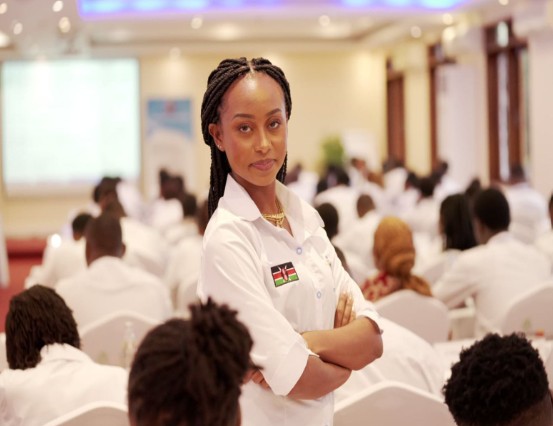
At 21 years old, Martha Whitney is already charting a bold course for herself and others. Born and raised in Nairobi, Martha once dreamed of becoming a pilot. It was an exciting vision, but like many young people with big dreams and limited resources, the path slowly became less realistic. What she didn’t expect was for a school-based innovation challenge to unlock a new dream just as bold, but more grounded in purpose.
When she joined the Wavumbuzi Entrepreneurship Challenge in high school, Martha was curious about entrepreneurship but unsure of where to start. She had ideas, but no roadmap. She didn’t yet have the confidence to lead or the tools to turn ideas into action.
Through its hands-on innovation quests, Martha learned to think creatively, lead with clarity, and navigate uncertainty, skills she hadn’t encountered in a traditional classroom. Winning the national challenge in 2019 was more than a personal milestone, it was a turning point. It proved that she was capable of much more than she had imagined.
When aviation studies became financially out of reach, Martha didn’t feel stuck, she felt equipped. With a new mindset, she enrolled in Economics at the University of Nairobi, determined to build something meaningful from the ground up.
From 2022 to 2024, Martha returned to Wavumbuzi as a national ambassador, mentoring other young changemakers across Kenya. She helped them believe in their ideas, just as someone had once believed in hers. In the process, she deepened her leadership, empathy, and communication skills she now sees as central to who she is becoming.
Today, Martha is working toward launching her own venture. The lessons and perspective she gained from Wavumbuzi continue to shape her path.
She knows her journey didn’t follow the path she first imagined but it led to something greater: a future where she’s not just growing, she’s helping others rise too.
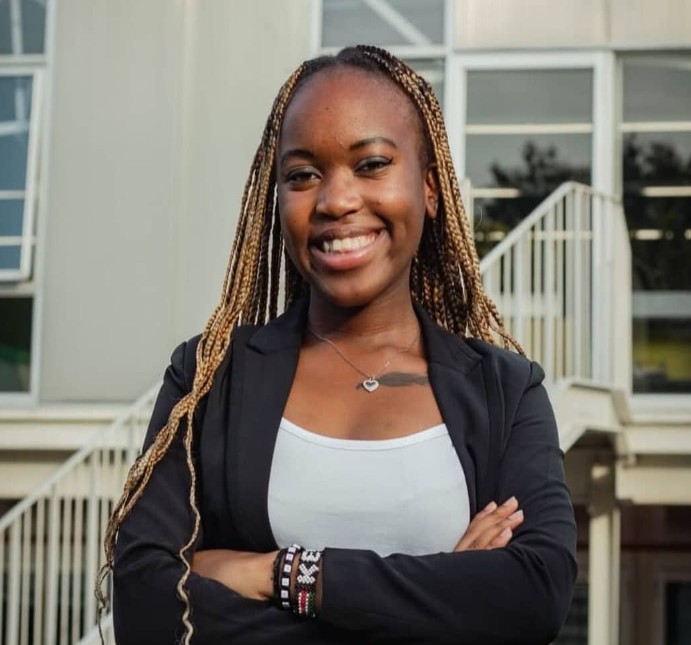
In 2019, Laurier Somi was a teenage student in a Kenyan boarding school, curious but not especially confident, and certainly not seeing herself as an entrepreneur. When she first heard about the Wavumbuzi Challenge, she hesitated. It sounded like something meant for students who already understood business or knew how to pitch ideas. But curiosity nudged her forward. She decided to try without a plan, without polish, just a willingness to learn.
That simple decision marked the beginning of a transformation.
Wavumbuzi became more than just a school competition. It exposed her to real-world issues like food insecurity, unemployment, housing and made them feel solvable. Through weekly innovation quests, she stopped asking “Why me?” and started asking “What can I do?”
Her first idea was modest but powerful: to rally students over the school holidays to sell samosas and smokies, using the profits to buy food for vulnerable families in the Mukuru slums. With no prior pitch experience and a busy exam schedule, she borrowed a teacher’s phone and filmed her submission after class. It was shaky, full of self-doubt, and far from perfect. But it was hers, her vision, her voice, and her first act of leadership.
That pitch didn’t win. But it sparked something far more lasting. It became the seed for what would later grow into the Somi Foundation, a youth-led initiative focused on food security, education access, and environmental stewardship.
Through Wavumbuzi, Somi didn’t just discover a project, she discovered herself. She developed entrepreneurial competencies like initiative-taking, opportunity recognition, and value creation. She learned to lead without needing permission, to ask better questions, and to take bold risks in service of others. One of those risks led her to explore affordable housing, which unexpectedly sparked a passion for real estate. Today, she’s preparing to study Real Estate and Marketing in Japan.
Her growth didn’t stop at school. After high school, she crowdfunded her way to the African Leadership Academy in South Africa, using Mchanga and rallying her networks. At just 21, she now leads a remote team of six volunteers, to drive impact. Her foundation has partnered with over ten youth organizations, delivered donations to children’s homes, and helped more than a dozen students access international scholarships.
Somi has been recognized for her impact, earning a nomination for the Green Kids Award in 2022 for her work in climate change awareness, and an honorary mention from the Africa Youth Awards. Her grassroots leadership has mobilized youth in Imara Daima and beyond, inspiring them to take action through education, environmental conservation, and community development.
One of her most impactful contributions is her consistent work with children’s homes,donating food, clothes, books, and sanitary towels, while also planting fruit trees and teaching environmental responsibility. What sets her apart is her ability to mobilize communities without relying on external funding, proof of her resilience, creativity, and deep belief in grassroots empowerment.
Her vision for the future is clear: by 2031, she aims to build a movement of 2,000 empowered youth,not just receiving help, but solving problems, creating jobs, and giving back to their communities.
Somi’s story is proof of what can happen when one young person says yes to a challenge.
Wavumbuzi didn’t just give her the tools to lead.
It gave her permission to believe she could.
And she’s just getting started,because Somi isn’t just part of the change. She is the change.
Wavumbuzi 7 years Longterm Impact Report

